

Non AI Generated Children Books: A Parent's 2026 Guide
Table of Contents
- Why Non AI Generated Children Books Matter for Early Development
- How to Identify AI-Generated Books: A Parent's Verification Checklist
- Best Children Books for 2026: What to Look For
- Human-Authored vs. Machine-Generated: A Side-by-Side Comparison
- Supporting Independent Authors and Ethical Publishing
- Building a Non AI Library for Your Child
- Frequently Asked Questions
Last Updated: September 14, 2026
Why Non AI Generated Children Books Matter for Early Development
Non AI generated children books are written and illustrated by real people, not assembled by machine learning models trained on scraped text and images. At Quill and Compass Books, we've watched the market fill with algorithmic titles that look like books but skip the human work of storytelling: the revision, the artistic training, the lived experience that gives a story its emotional resonance.
The research on early literacy points in one direction. The American Academy of Pediatrics guidance on reading with young children recommends daily shared reading from infancy because back-and-forth interaction, not just exposure to words, drives language development. A machine can generate grammatically correct sentences. It cannot sit with a child and notice which page makes them laugh.
The Emotional Gap Between Human and Algorithmic Storytelling
Bedtime stories do quiet work flashcards can't. When a parent reads a human-authored book, the child hears rhythm, pacing, and warmth chosen by someone who understands how a three-year-old's attention rises and falls.
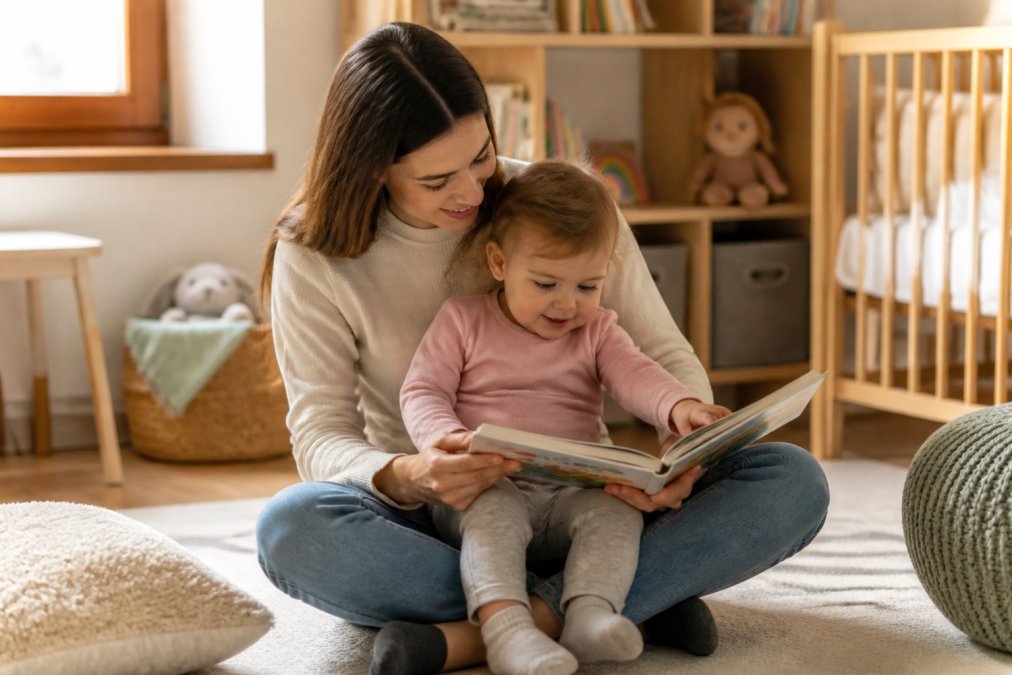
Algorithmic content flattens those choices. Models imitate a story's shape but miss artistic nuance: the pause before a punchline, the illustration detail a child returns to night after night. For infants and toddlers, that human touch is the whole point.
How to Identify AI-Generated Books: A Parent's Verification Checklist
Most advice stops at "the pictures look weird", a hunch, not a checklist. What follows is a five-minute verification you can run in a bookstore or on a product listing, built around the failure modes image and text models produce.
Start With the Metadata, Not the Story
Before you read a sentence, check the book's paper trail. Machine-generated titles slip up here most often, because metadata is tedious and expensive to fake convincingly.
- ISBN and publisher address. Confirm the publisher has a verifiable address and a catalog of titles that make sense together. A "publisher" with 40 unrelated titles released in one month is a bulk operation.
- Author footprint. Search the author's name plus "interview," "school visit," or "bookstore event." Human children's authors leave a trail: a website, a newspaper feature, a library reading, a podcast. A name that exists only on retail listings is a warning sign.
- Publication velocity. Check how many titles the author or imprint released in the past 90 days. A debut author with six picture books in one quarter is not a debut author.
Reading the Illustrations Like an Editor
Illustration is where generative image tools leave the most evidence. You don't need an art degree, scan each spread in this order:
- Hands and fingers. Count them and check the joints. Models routinely produce four fingers, fused fingers, or a misplaced thumb.
- Eyes and symmetry. Both eyes should point the same direction with pupils inside the iris. Cross-eyed or mismatched pupils are common.
- Background continuity. Follow one background object, a chair, a tree, a lamp, across every page. Human illustrators keep a consistent world; models regenerate it and drift.
- Text inside the art. Signs, book spines, labels, and chalkboards are where models produce gibberish lettering. Real illustrators letter these deliberately.
- Lighting logic. Find the shadows and ask where the light source is. If character and background shadows disagree, the image was assembled rather than drawn.
- Style consistency. Flip from page one to page twenty. A human illustrator holds a style; models often shift line weight, palette, and rendering between spreads.
Reading the Text Like a Copy Editor
Text problems are subtler than art problems but follow patterns. Read the book aloud, the ear catches what the eye misses.
- Rhyme that scans but does not mean. Perfect meter with no emotional stakes is a signature of text generated to a pattern.
- Repetition without purpose. The same adjective, sentence shape, or transition on every page.
- Character names that drift. A character called "Mia" on page three and "Maya" on page nine.
- Tense and point-of-view slips. A story that starts in past tense and quietly shifts to present.
- Generic specificity. A story set in "a beautiful forest" rather than a forest with a name, a season, and a reason.
- No interiority. Characters act but never want anything specific. Human authors give even a board-book rabbit a clear desire on page one.
The Five-Minute Verification
Run this before any book reaches your shelf:
- The publisher has a verifiable address and a coherent catalog.
- The author has an online footprint beyond retail listings.
- Hands, eyes, and background objects hold up across every spread.
- Any text inside the illustrations is spelled correctly.
- The story has a specific point of view and a character who wants something.
- Reading it aloud does not expose rhyme or tense problems.
If a book fails two or more of these, put it back, and if it fails the copyright page, put it back regardless of the cover.
Best Children Books for 2026: What to Look For
The best children books for 2026 share three traits: durable construction, human authorship, and stories built around emotional resonance rather than keyword trends. Board books still win for the under-five set because they survive the chewing, throwing, and page-ripping that comes with the territory.


Look for thick board pages, rounded corners, and non-toxic inks. Then look past the physical book at the story itself. A good test: does the book have a moment your child will want to talk about? Human authors build those moments deliberately. Algorithms produce text that reads fine and lands nowhere.
Board Books Built to Survive Toddlers
A 6x6-inch board book with 24 pages is the workhorse format for infants through preschoolers. It fits small hands, survives drops, and holds up to repeated bedtime readings.
Quill and Compass Books publishes board books designed for exactly this stage. The Ollie and Friends series follows a little rabbit through everyday adventures, with hand-drawn illustrations and stories built around kindness and curiosity. Titles like Ollie Bunny ($8.99) and Ollie Bunny and the Adventure Down Winding Lane ($8.99) are written for the toddler attention span, not padded to hit a word count.

Ollie Bunny
Human-Authored vs. Machine-Generated: A Side-by-Side Comparison
A table of adjectives does not help you choose a book. What helps is knowing what to evaluate, how to evaluate it, and the trade-offs in practice, plus a way to score any book yourself.
The Criteria That Actually Separate the Two
Criteria |
Human-Authored Books |
Machine-Generated Books |
Why the Difference Exists |
|---|---|---|---|
Authorship |
Named author with a verifiable body of work |
Anonymous or generic author bio |
Human authors build a public record over years; generated titles are often published under pen names with no history. |
. |
|||
Story structure |
Character wants something, faces a cost, changes |
Formulaic beats with thin stakes |
Human authors revise against a child's attention; models optimize for plausible text, not for emotional arc. |
Language |
Rhythm, pacing, and word choice tuned for read-aloud |
Grammatically correct but flat |
Read-aloud quality comes from repeated testing with real children, which models do not do. |
Copyright status |
Clear rights and credits |
Ownership often unclear |
Under U.S. Copyright Office guidance on authorship and registration, copyright protects human-created works, so purely machine-generated content sits in murky territory. |
Longevity |
Re-readable for years |
Loses appeal after a few reads |
Human books reward re-reading because children find new details; generated books tend to exhaust their content on the first pass. |
Publisher transparency |
Discloses editorial and illustration process |
Rarely explains how the book was made |
Transparent publishers have a process to describe; bulk operations usually do not. |
What the Table Does Not Tell You
The table is a starting point, not a verdict. Two things matter more than any row.
First, the gap widens over time. A machine-generated book can pass a first read. Problems show up on the fifth or twentieth, when your child notices the rabbit's ears changed shape, the rhyme doesn't land, or the story never goes anywhere. Human-authored books get better with repetition because there are layers to find.
Second, the trade-offs are real on both sides. Machine-generated titles are cheaper and faster to produce, and a few are fine as disposable entertainment. Human-authored books cost more because a person spent months on them, and that cost is the point: the revision, the artistic training, the specific child the author had in mind.
Scoring Any Book in Two Minutes
Use this method when comparing two books side by side. Give each book one point per yes.
Author: Is there a named author with a findable body of work?
- Consistency: Do the illustrations hold a consistent style and world across every spread?
- Story: Does the main character want something specific and face a real cost?
- Read-aloud: Does the text sound good when you read it out loud?
- Transparency: Does the publisher explain how the book was made?
A score of 4 or 5 is a strong signal. A score of 2 or 3 means proceed with caution. A score of 0 to 2 means you are almost certainly looking at a bulk-produced title.
The Question That Cuts Through Everything
If you remember one test, make it this: can you name the person who made this book, and can you find them?
Human-authored children's books have a person behind them, a website, a portfolio, a school visit schedule, a local bookstore event. Machine-generated books have a listing. That question filters out most of what you want to avoid, in about thirty seconds.
Supporting Independent Authors and Ethical Publishing
Ethical publishing means paying real authors and illustrators for real work and being honest with buyers about how a book was made. Buying from an independent publisher sends more of your money to the people who created the story.
The U.S. Copyright Office guidance on authorship and registration is clear that copyright protects human-created works, which is why so many algorithmic titles have murky ownership. That murkiness is a signal, not a technicality.
Independent authors also tend to write with a specific child in mind, not a keyword. That specificity is what makes a story stick. Supporting them is a small, repeatable choice: buy one book at a time from a publisher you can name, and skip the bulk listings with no author attached.
Building a Non AI Library for Your Child
Building a library of non AI generated children books is less about volume than curation. Ten hand-picked, human-authored books do more for early literacy than fifty algorithmically generated ones.
Start with a small core: two or three board books, a couple of bedtime stories with strong rhythm, and one or two books whose illustrations your child gravitates toward. Add slowly, and note which stories get requested again.
Quill and Compass Books was founded in 2025 with this approach in mind: wholesome storytelling, carefully crafted board books, and a focus on curiosity, kindness, and creativity. The Ollie and Friends series, including Ollie Bunny and The Quest for The Perfect Pumpkin ($8.99), is built for parents who want to know exactly who wrote and drew the book in their child's hands.
The National Center on Improving Literacy family resources offers free guidance on choosing books that match a child's developmental stage, which pairs well with a curated, human-authored shelf.
Frequently Asked Questions
How can I tell if a children's book was generated by AI?
Look for inconsistent illustration details like extra fingers or mismatched shadows, generic author bios with no history, and text that feels repetitive or lacks emotional depth. Check if the publisher lists a real person behind the art and story. Human-authored books typically credit a specific illustrator and author with verifiable backgrounds. If the publisher won't confirm human authorship, treat it as a red flag.
Are AI-generated children's books illegal?
Not automatically. U.S. copyright law currently requires human authorship for protection, so purely AI-generated content may not qualify for copyright. However, selling AI-generated books isn't illegal by itself. The bigger concern for parents is quality and developmental value, not legality. Some AI books also raise copyright infringement issues if they were trained on or mimic protected work without permission.
What are the best children books for 2026 for toddlers?
Look for board books with thick pages, rounded corners, and non-toxic inks. Stories should feature simple narratives with emotional resonance. Series like Ollie Bunny offer consistent characters children bond with across multiple books. Check that illustrations are hand-drawn or clearly credited to a human artist. Independent publishers focused on bespoke storytelling often deliver higher quality than mass-produced AI titles.
Why do parents and educators prefer human-authored children's books?
Human-authored stories carry emotional resonance that algorithmic content struggles to replicate. Children's literature relies on artistic nuance, pacing, and warmth built through a real creative process. Research on child development suggests that reading books with genuine narrative intent supports language acquisition and emotional intelligence more effectively than formulaic text. Parents also value content authenticity and want to support independent authors.