

Engaging Stories for Preschoolers: 7 Read-Aloud Picks
Table of Contents
- What Makes a Story Engaging for Preschoolers?
- 1. Ollie Bunny: A Gentle Day on Winding Lane
- 2. Ollie Bunny and the Adventure Down Winding Lane: A First-Errand Story
- 3. Ollie Bunny and The Quest for The Perfect Pumpkin: A Fall Favorite
- Why Durable Board Books for Toddlers Matter
- Interactive Read-Aloud Techniques That Work
- How to Keep Preschoolers Engaged During Storytime
- Frequently Asked Questions
Last Updated: September 11, 2026
What Makes a Story Engaging for Preschoolers?
An engaging story for preschoolers is a short narrative built on a simple arc, a memorable refrain, and illustrations a child can point to and name, and the most engaging stories are the ones a child asks to hear again. Most three-to-five-year-olds can follow a read-aloud for roughly five to ten minutes before attention drifts (healthychildren.org). This guide covers what holds a preschooler's attention, plus read-aloud picks worth adding to your shelf.

Preschool literacy research consistently points to the same ingredients: rhythm, repetition, and a character a child recognizes as a friend. NAEYC guidance on early literacy notes that early childhood development grows fastest when children hear language in playful, repeated patterns rather than one-off lessons. That is why the best engaging stories for preschoolers feel less like instruction and more like play.
Most book lists rank titles by popularity instead of by how well a story performs at 7 p.m. with a tired child on your lap. A story earns its place when it survives the tenth reading, when your child finishes the refrain before you do, and when the pictures reward a second look.
Below, we break down what makes a story work, then walk through seven picks, interactive read-aloud techniques, and the durability question every parent of a two-year-old asks.
1. Ollie Bunny: A Gentle Day on Winding Lane
Start here for a calm, low-stakes story that settles a child rather than winds them up. Ollie Bunny is a little rabbit who lives in a burrow at the end of Winding Lane with Mama Rabbit and Papa Rabbit. She loves her ribbon, her garden, and her basket, but loves Mama and Papa most of all.

The plot is deliberately small, a single day in a burrow, and that is the point. For a two- or three-year-old, the familiar beats of waking, playing, and coming home provide comfort rather than suspense. The board book runs 6x6 inches and 24 pages, sized for small hands to hold independently.
A common mistake is skipping books like this because "nothing happens." Quiet domestic stories build vocabulary around daily routines, exactly the language acquisition ground preschoolers need. This is Book 1 in the Ollie and Friends series.
2. Ollie Bunny and the Adventure Down Winding Lane: A First-Errand Story
If your child is ready for more plot, this second book delivers it without raising the stakes too high. Today Ollie gets to hop down Winding Lane on her own for her first errand, past the homes of all her friends, to visit Uncle Ron Rabbit, Aunt Kelly Rabbit, and cousin Samuel Rabbit.
First-errand stories are quietly powerful for character-building. The tension is real but safe: will she make it, and what will she find along the way? Children this age test their own independence in small ways, and seeing a character do the same builds empathy and confidence.
The format steps up to 32 pages, still a board book, still toddler safe. Expect it to take a minute or two longer at bedtime than Book 1, a natural bridge as attention span stretches.
3. Ollie Bunny and The Quest for The Perfect Pumpkin: A Fall Favorite
Seasonal stories earn their keep because they give you a reason to return to the shelf at a specific time of year. Autumn has arrived on Winding Lane, the leaves have turned red and gold, and it is time for the Great Pumpkin Festival. Papa Rabbit enters a decorated pumpkin every year, and every year Ollie and her friends search for the perfect pumpkin.
The quest structure introduces a goal, a search, and a satisfying finish, the simplest plot shape a preschooler can follow. It also opens post-story discussion: what makes a pumpkin perfect, and perfect for whom? That question lands differently for every child, which makes it worth asking.
This is Book 3 in the series, a 32-page board book, and it is available for preorder ahead of its September 30 release.
Book |
Pages |
Format |
Best For |
|---|---|---|---|
24 |
Board book, 6x6 in |
Calm bedtime wind-down |
|
Adventure Down Winding Lane |
32 |
Board book, 6x6 in |
First independence themes |
32 |
Board book, 6x6 in |
Seasonal and holiday reading |
Why Durable Board Books for Toddlers Matter
Durability is not a luxury feature; it is the difference between a book that gets read and one that gets replaced. Board books are printed on thick, rigid paperboard with rounded corners, which is why they survive chewing, throwing, and the enthusiastic page-turn of a two-year-old. American Academy of Pediatrics guidance on reading with young children encourages daily shared reading from infancy, and that habit only holds if the books on the shelf can take the handling.

Here is a test to consider before recommending any title: can it survive a drop from the couch, a chew on the corner, and a tug-of-war between siblings? If the answer is no, it may not last the month.
The parents who ask this most often already tried flimsy editions and watched them come apart. A board book that holds up means you buy once, not three times, and your child forms a real attachment to a specific copy. That attachment is where early readers are made.
Interactive Read-Aloud Techniques That Work
Reading aloud is not a performance; it is a conversation with a book in the middle. Interactive read-aloud techniques turn passive listening into active participation by giving a child a job for their hands, voice, and attention while the story unfolds. The difference between a storytime that holds and one that collapses is rarely the book, it is what the adult does between the pages.
Most practitioners group these techniques into four channels. Rotate across channels rather than stacking them all in one sitting, and match the channel to your child's temperament.
1. Verbal channel, build a refrain contract. Choose one repeated line and let your child own it. On the first reading, you say it. On the second, you pause and let them fill it in. By the fifth, they say it before you turn the page. This is the most reliable engagement mechanism at this age because it converts listening into anticipating. Children who "finish the refrain before you do" are also the ones who ask for the same book again, repetition is the reward, not the cost.
2. Visual channel, point, name, and search. Pause on an illustration and give a specific target: "Find the ribbon," "Where is the basket?" Then escalate to a two-step search: "Find the pumpkin that is next to the red leaf." Two-step directions stretch working memory, a milestone that separates a three-year-old from a five-year-old reader. Keep the search inside the illustration so attention stays on the book.
3. Physical channel, pair a motion with a page. Assign one movement to one recurring element: hop when the bunny hops, sway when the leaves fall, pat the page when the character is sad. This is the core of multisensory storytelling, and the technique most book lists skip. For children who need more sensory input, the motion is not a bonus, it keeps hands busy so ears can listen. A designated wiggle break between two short books often works better than demanding stillness through one long one.
4. Voice channel, give each character a consistent sound. Pick a pitch, a speed, or a sound effect for each character and keep it identical across every reading. Consistency lets a child track who is speaking without a name tag on the page. Vary volume for suspense and slow your pace at the turn of a page; the pause is the cliffhanger.
Adapting for shorter attention spans and sensory differences. Not every child engages through the same channel. A child with a short attention span often does best with the physical channel first and the verbal channel second; a child sensitive to loud sound may prefer the visual channel with a quiet, steady voice. Offer a fidget object, a cushion, or a wiggle break rather than requiring stillness, and let the child choose which of two books to read. Choice is itself an engagement technique, it converts a demand into a decision.
Post-story discussion prompts. The story does not end at the last page. Ask two or three open questions with no single right answer: "How do you think Ollie felt when she got lost?" "What would you have picked for the perfect pumpkin?" "What would you have done next?" These build narrative skills, vocabulary, and social-emotional learning at once, and cost nothing but a minute of your time. Keep the questions curious rather than corrective, the goal is association, not accuracy.
How to Keep Preschoolers Engaged During Storytime
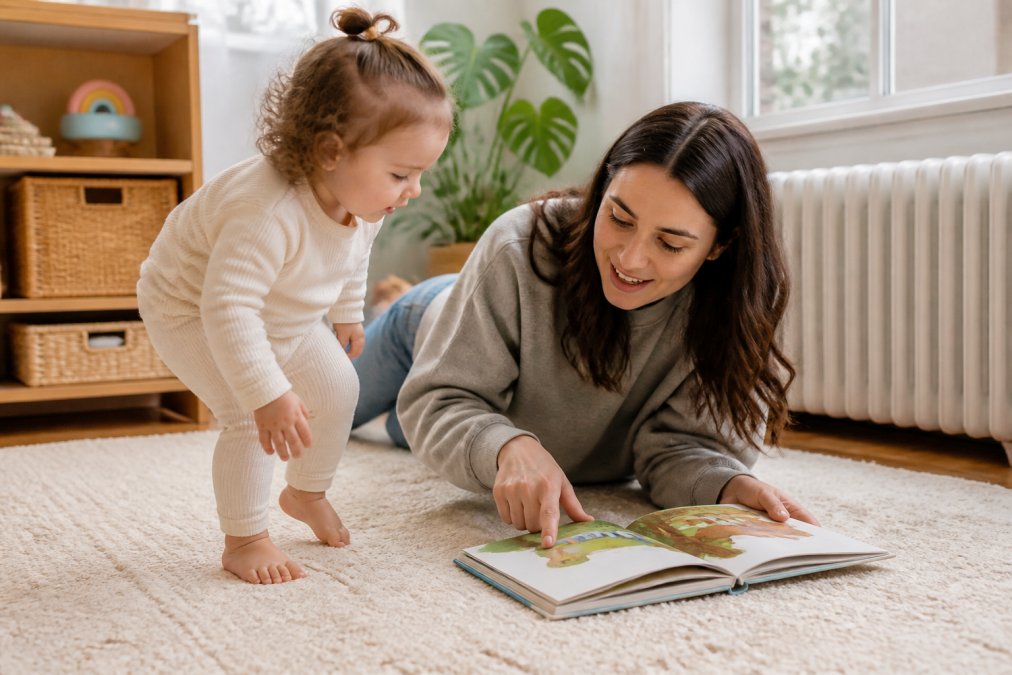
Keeping a preschooler engaged during storytime comes down to three levers: timing, choice, and participation. Read when your child is fed and rested rather than overtired, let them pick from two or three options rather than the whole shelf, and build in a job for them on every page. What separates a storytime that works from one that does not is how you handle the moments when attention breaks, and it will break.
Timing: match the book to the window, not the clock. Attention span at this age is short and variable, and that is normal. A useful rule of thumb is roughly two to five minutes of focused listening per year of age, so a three-year-old may give you six to fifteen minutes on a good day and far less on a tired one. Read the shorter book in the tired window and save the longer one for after a nap or a meal. A child who wanders off mid-book is not rejecting reading; they are being three. The fix is usually a shorter book, a more active reading style, or a different time of day.
Choice: two options, not the whole shelf. A binary choice, "this one or that one?", gives a child ownership without overwhelming them. A common pattern is that the child picks the same book for two weeks straight. Let them. Repetition is how comprehension deepens, and the tenth reading is where the refrain, the vocabulary, and the emotional beats land.
Participation: a job on every page. Give the child something to do that is not "sit still and listen." Turn the page, hold the book, find the object, say the refrain, make the sound. When a child has a job, stillness stops being the requirement.
When attention breaks, change one variable. Do not abandon the session; adjust it. Shorten the book, switch to the physical channel, offer a wiggle break, or move to a different spot. Ending on a high note while your child still wants more is better than pushing to the last page and ending in frustration.
Stories for neurodivergent preschoolers. Children with sensory processing differences or shorter attention spans often need a different setup, not a different child. Practical adjustments:
- Offer a fidget object, a weighted lap pad, or a cushion so the body has input while the ears listen.
- Build in a designated wiggle break between two short books rather than demanding stillness through one long one.
- Reduce background noise and visual clutter in the reading space.
- Preview the book: flip through the pictures first and name what is coming, so the story is not a surprise.
- Let the child choose the order of two books, or choose whether to sit or stand.
- Keep the session short and predictable, and end on a high note while your child still wants more.
Post-story discussion prompts. Extend the value of a single book with two or three open questions: "How do you think Ollie felt when she got lost?" "What would you have picked for the perfect pumpkin?" "What would you have done next?" Ask, then wait, a five-second pause is often enough for a preschooler to assemble an answer. These prompts build narrative skills, vocabulary, and social-emotional learning at once, and cost nothing but a minute of your time.
Frequently Asked Questions
What makes a story engaging for a preschooler?
Engaging stories for preschoolers share a few traits: simple sentences, predictable rhythms, and illustrations that match the words. Characters close to a child's own world, like a bunny who loves her mama and papa, hold attention longer than abstract plots. Repetition also helps. When a preschooler can guess the next line, they stay involved and feel like a reader themselves.
How do I choose durable board books for toddlers with short attention spans?
Look for thick pages, rounded corners, and a size small enough for little hands to hold. A 6x6 inch board book with 24 to 32 pages works well for toddlers because it is short enough to finish before attention drifts. Check that pages are sealed and wipe-clean, since chewing and tossing are normal. Durable board books for toddlers should survive drops, teething, and repeated reads.
What are some interactive read-aloud techniques I can try tonight?
Try pausing before a repeated phrase and letting your child finish it. Point to pictures and ask simple questions like 'Where is the bunny?' Use different voices for each character. You can also add hand motions for actions like hopping or sleeping. These interactive read-aloud techniques turn a passive listening session into a back-and-forth game, which builds comprehension and vocabulary.
How can I keep my preschooler engaged during storytime when screens are more exciting?
Make storytime a physical, social event. Let your child hold the book, turn pages, or act out parts of the story. Keep sessions short, around five to ten minutes, and stop before they lose interest. Pair reading with a related activity, like hunting for a pumpkin after a fall story. A consistent routine, same time and same cozy spot, also helps reading compete with screens.
Are board books actually good for early literacy and emotional development?
Yes. Board books support early literacy by building phonological awareness, vocabulary, and narrative skills. Stories with kind characters and simple conflicts help preschoolers practice empathy, sharing, and compromise. When you talk about how a character feels, you reinforce social-emotional learning. The format itself, sturdy and easy to hold, gives toddlers a sense of ownership over reading, which builds confidence.